
Create a named auction event, catalog your lots, set staggered closing times — and let buyers bid across all lots simultaneously. Estate sales, liquidations, antiques, vehicles, farm equipment. One platform, unlimited events, zero per-event fees.
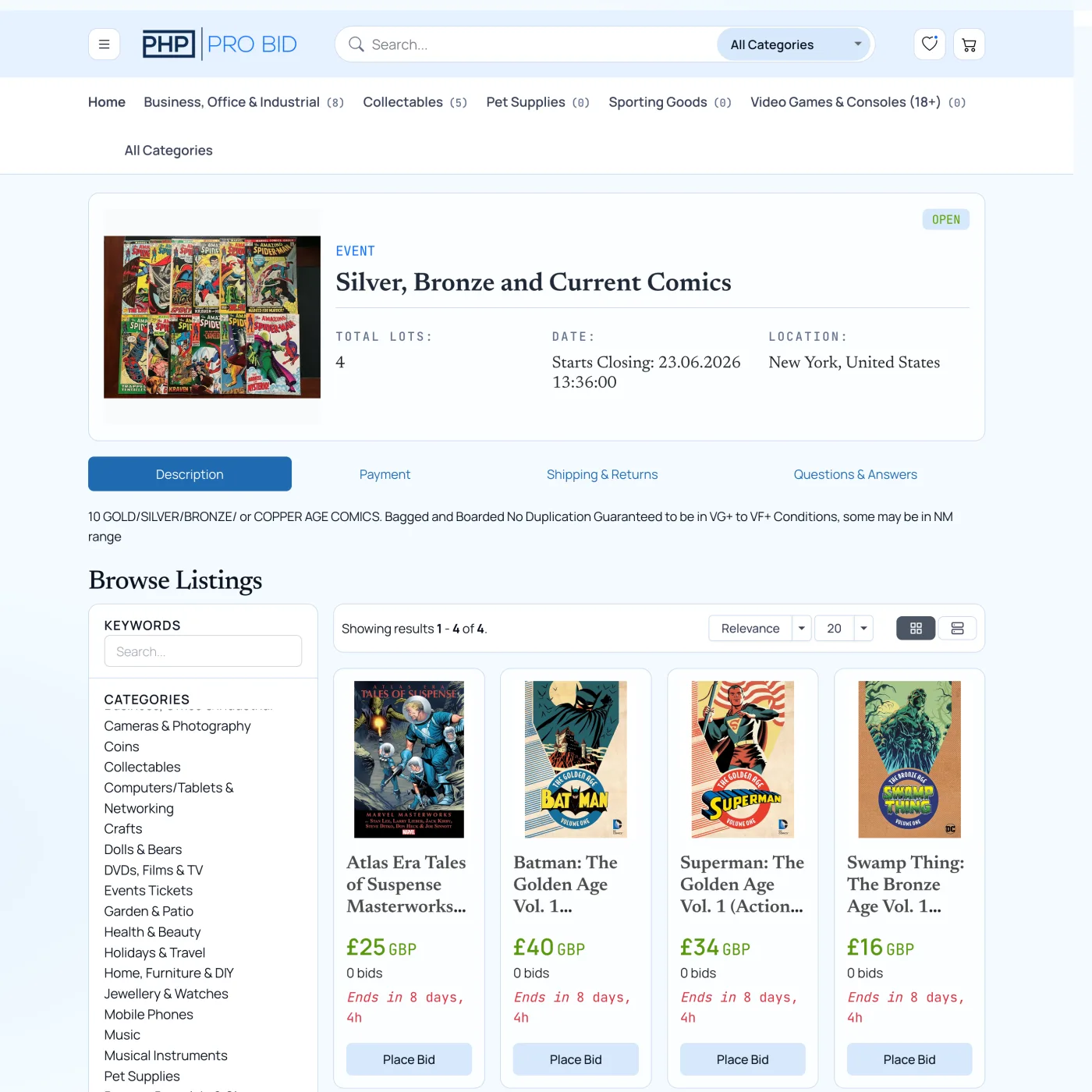
An auction event is a scheduled sale with a defined catalog of lots, each with its own opening bid, reserve, and closing time. Unlike always-on timed auctions where individual items are listed whenever you like, an event has a name, a date, and a logical sequence — lot 1 closes first, then lot 2, three minutes later, then lot 3, and so on through the catalog.
This format maps directly onto how commercial auctioneers work: an estate sale is an event, a liquidation is an event, a monthly antiques sale is an event. Buyers register in advance, browse the full catalog before bidding opens, and compete across multiple lots in a single session. When a bid comes in during the final minutes, the lot automatically extends — giving other bidders time to respond without the rest of the sale being disrupted.
The critical difference from SaaS event platforms: per-event pricing is the norm across the market. Platforms charge £800–£1,999 per event on top of a monthly subscription, plus a percentage of gross sales. PHP Pro Bid charges for the software once. Run 2 events a year or 200 — the price is the same.
A real cataloged event on PHP Pro Bid — the event header with total lots, closing date, and location, above the full lot catalog buyers browse and bid across.
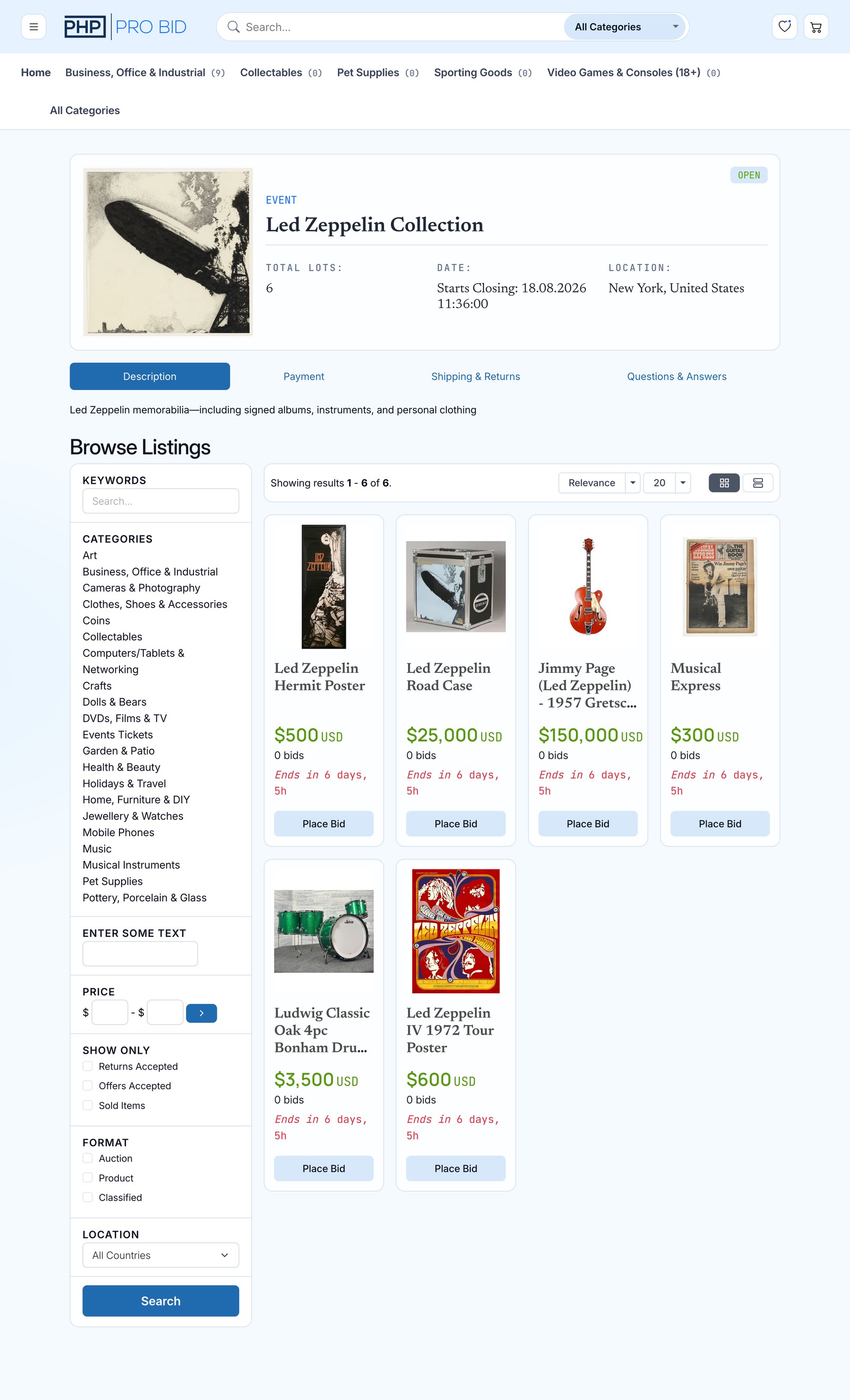
In a traditional room auction, bidding on one lot closes before the next opens. Online, staggered closing replicates this: lots close sequentially, a few minutes apart, creating natural competitive momentum across the entire catalog.
Bidders can follow multiple lots at once. A soft close on any lot (triggered when a bid arrives in the final minutes) extends that lot only, without disrupting the rest of the sequence.
Name your event, set the opening date, and configure buyer registration requirements. The event is visible in your catalog before bidding opens.
Add lots individually or bulk-import via CSV. Set opening bid, reserve, and images per lot. Arrange the closing order by drag-and-drop.
Choose your closing interval — 2, 3, 5 minutes or custom. The system calculates and assigns every lot's closing time automatically. Soft-close extension is configurable.
When the last lot closes, PHP Pro Bid automatically consolidates each buyer's winnings into a single invoice. Payment links included. Unsold lots can be relisted instantly.
The Auction Events format isn't defined by what you sell — it's defined by how you sell. Any business running a dated, cataloged sale with competitive bidding is running an auction event.
Clear a complete property contents in a single event. Furniture, art, jewelry, collectibles, kitchen — all cataloged as lots, all closing sequentially over hours or days. Buyers get a full catalog preview; you get consolidated invoices and no per-lot fees.
Retail closedowns, restaurant equipment, office contents, stock clearance. Run as a timed event with the full asset list published in advance. Buyers bid across the whole asset list from one place. Post-sale invoicing and removal scheduling built in.
Classic cars, fleet disposals, trade auctions, motorcycles. Each vehicle is a lot with its own reserve, condition report, and photo gallery. Buyers can inspect the catalog before the event opens. Reserved bidder approval keeps unqualified bidders out.
Monthly or quarterly cataloged sales — the traditional model for established auction houses. Long preview periods, reserve-heavy lots, absentee (proxy) bidding prominently used. Multiple events per year on the same platform with no incremental cost.
Retirement dispersal sales, seasonal equipment auctions, livestock dispersals, and farm tools — sold as timed lots rather than a live ring. High-value lots often with complex descriptions, VIN/serial numbers, and multiple photos. Bulk catalog import from CSV saves hours of data entry.
Plant closures, manufacturing equipment, office fitouts, warehouse contents. Often involves restricted-access bidder registration, removal scheduling, and lot-level compliance terms. PHP Pro Bid supports per-lot custom terms and manual buyer approval.
Weekly, monthly, or quarterly sales run by established auction businesses. Multiple events running simultaneously on the same platform — last week's event wraps while next week's catalog is already live. Relist events to speed up repeat setups.
Photo-led lots with grading notes, provenance, and certificates of authenticity. Collectors search by category, period, and maker. The fixed-price shopping cart runs alongside the auction, letting buyers purchase buy-now items in the same session.
Retail returns, overstock, ex-display, end-of-line. Run timed events to clear inventory quickly without third-party marketplace fees. Bulk-import item lists from a spreadsheet. Your cost to sell stays flat regardless of GMV.
Built for businesses running real cataloged sales — not adapted from a general e-commerce platform.
Set a closing interval — 2, 3, 5 minutes or custom. The system automatically staggers every lot's close time across the catalog. Adjustable per event.
A bid placed in the final minutes automatically extends the lot's closing time. Only that lot extends — the rest of the sequence continues unaffected.
Bidders set a maximum they're willing to pay. The system bids automatically on their behalf up to that limit. Essential for cataloged antiques and fine art sales.
Upload hundreds of lots at once from a spreadsheet. Map columns to lot fields — title, description, opening bid, reserve, category, photos. Saves hours on large catalogs.
When the last lot closes, PHP Pro Bid automatically generates a consolidated invoice for each winning bidder across all their lots. Fees applied automatically.
Require registration before bidding opens. Approve buyers manually or automatically. Block unverified bidders from high-value catalogs.
Configure flat listing fees, per-category fees, and reserve pricing, globally or per event. Full control — the platform never takes a cut of your sales.
Carry a previous event's settings — fees, registration rules, terms, layout — into a new event. Rebuild your next sale in minutes instead of starting from scratch every time.
The standard model for auction events software is a monthly subscription plus a per-event fee, plus a percentage of gross sales. That's three layers of cost on top of each other. PHP Pro Bid charges for the software — once, or monthly. Run as many events as you want for the same price.
License £399 one-time · Cloud from £63/mo · VPS from £159/mo · Zero transaction fees on all plans
Always-on individual listings with their own closing time. Ideal for continuous selling alongside your scheduled events.
Fixed-price listings running alongside your auctions. Same buyers, same session, one combined checkout.
The complete guide to running online estate sales — cataloging, pricing, buyer registration, and settlement.
88 features across users, bidding, fees, payments, shipping, and admin. Browse by what matters to your operation.
License £399 one-time · Cloud from £63/mo · VPS from £159/mo. All plans include Auction Events. Zero per-event fees.
The full platform overview — timed auctions, live events, and marketplace formats in one install. The hub for every auction type.
Run silent auctions, galas, and fundraising events on the same platform — no per-event fees, zero cut of funds raised.
See a working auction event from the bidder's side. No sign-up required — try placing a bid before you decide.